
Chu Văn An

Nội dung bài viết
From the beverage can you hold in your hand to the airframe of an ocean-going aircraft, Aluminum is the strategic metal that has shaped the modern world. What makes a light metal (only 1/3 of steel) so resistant to corrosion? Why is it one of the few metals that can dissolve in both strongly acidic and alkaline solutions?
Trường Chu Văn An, with more than 20 years of experience in the chemical industry, will delve into the chemical “soul” of Aluminum. Instead of just listing, we will thoroughly analyze key properties (such as amphotericity, aluminum thermoreactivity) and production process (melt electrolysis) to provide you with the most comprehensive and professional view.
What element is aluminum? Overview of technical specifications (Al)
Aluminum (international name: Aluminum) is a chemical element with the symbol Al and atomic number 13. In terms of classification, this is a metal belonging to group IIIA in the periodic table, with a characteristic silvery white color. However, the surface of aluminum often fades quickly because it forms a thin, durable oxide film when exposed to air—this is also the self-protection mechanism that helps aluminum resist corrosion.
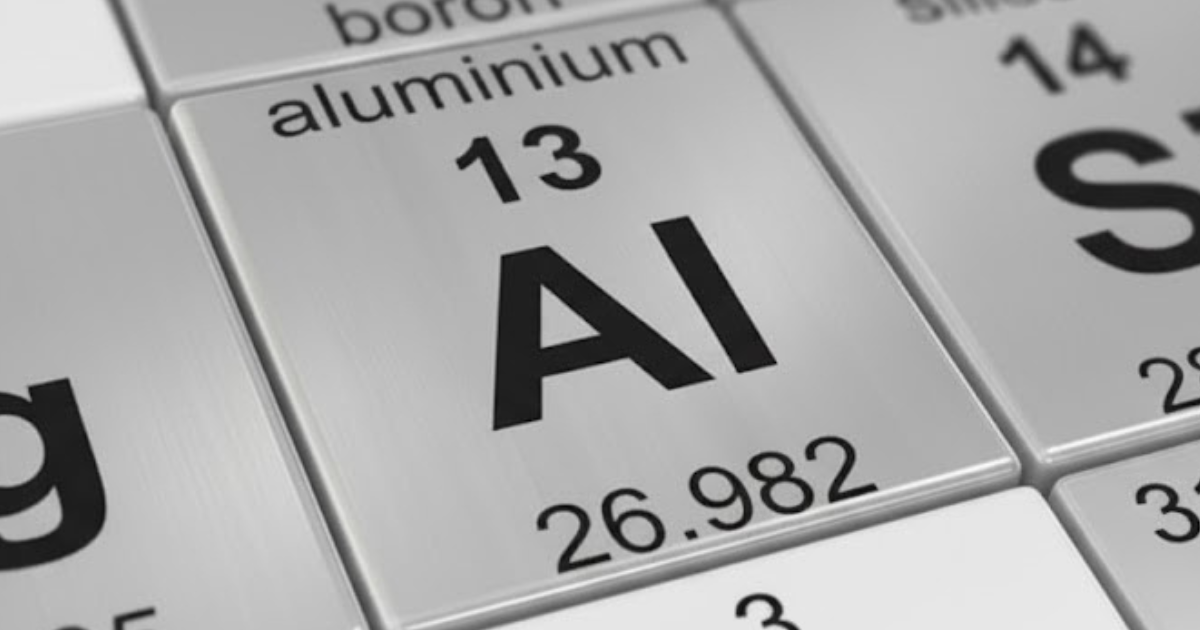
AL in the periodic table
With an atomic mass (M) of approximately 27 (26.98 g/mol to be exact) and low density, aluminum is an ultralight metal. It is the third most abundant element in the Earth’s crust (after Oxygen and Silicon) and the world’s second most industrially important metal, after Iron (Fe), with wide applications from aerospace to consumer goods.
Trường Chu Văn An has compiled core information in the table below for you to easily look up.
|
Attributes |
Detailed specifications |
|
Element name |
Aluminum (often called Aluminum) |
|
Chemical symbols |
Al |
|
Atomic number (Z) |
13 |
|
Atomic mass (M) |
26.98 g/mol (usually rounded to 27) |
|
Electron configuration |
3s² 3p¹ |
|
Location |
Box 13, Cycle 3, Group IIIA |
|
Electronegativity (Pauling Scale) |
1.61 (relatively low) |
|
Common oxidation numbers |
+3 |
|
Status (normal condition) |
Solid (Metal) |
(Source: Data compiled from PubChem, US National Institutes of Health – NIH)
Characteristics of Aluminum: Outstanding physical properties
The applications of aluminum are not accidental; they come directly from its unique physical characteristics:
- Light weight (Ultra light): This is the biggest advantage. Aluminum has a density of only about 2.7 g/cm³, 1/3 lighter than steel or copper. This property makes it a “golden” material for the aviation, space and transportation industries, where weight reduction means fuel savings.
- Flexibility, toughness and ease of processing: Aluminum is very flexible (second only to gold). It can easily be rolled into foil (like food wrappers), spun into fibers (to make electrical wires) or extruded into complex profiles (to make door frames) without cracking or breaking.
- Good electrical and thermal conductivity: Aluminum conducts electricity well, only about 2/3 of that of copper (Cu). However, because aluminum is much lighter than copper, with the same power transmission capacity, aluminum wire is nearly half as light as copper wire. This is why it is often used as high voltage electric cables (usually with steel core to increase bearing capacity). It also dissipates heat very well, being used in computer CPU coolers and LED lights.
- Corrosion resistance (Self-protection): As mentioned in the Sapo section, aluminum is very durable in air and water. This is the “key” to its durability, and Trường Chu Văn An will explain more clearly in the chemical properties section below.
- Melting temperature: Aluminum has a relatively low melting temperature (compared to other metals) of 660.32 °C, making smelting, casting and recycling easier and more energy efficient.

What is AL?
Chemical properties of Aluminum (Al): Strong reduction and amphotericity
From the perspective of Trường Chu Văn An’s expertise, all applications and production processes of Aluminum revolve around two characteristics: strong depolarization and amphiphilicity.
The origin of these two properties comes from its electron configuration ([Ne] 3s² 3p¹). With 3 electrons in the outermost layer, Aluminum always tends to “donate” all 3 electrons to achieve the stable configuration of the noble gas Neon (Ne).
- Strong reducing properties: The ease with which 3 electrons are lost (Al → Al³⁺ + 3e) makes Aluminum a leading reducing agent. This power is measured by the standard Electromotive force (E⁰(Al³⁺/Al) = -1.66V). This number is very negative, proving that it has stronger reducing properties than Hydrogen (H₂) and many other metals such as Iron (Fe), Zinc (Zn). This is the chemical basis of the aluminum thermal reaction.
- Bisexuality: This is the most special “personality trait”. Unlike Iron or Copper (which are only soluble in acids), Aluminum is able to react with both acidic solutions and strongly alkaline solutions (like NaOH).
However, this strong reduction creates a big contradiction: If aluminum is so chemically active, why are our pots and pans and door frames durable? The answer lies in the oxide “armor plate” that we will analyze shortly.
Oxide film (Al₂O₃) – Decoding the paradox: Why is aluminum durable?
A great paradox: Aluminum has very strong reducing properties (stronger than Zinc and Iron), it should react violently with oxygen and water. But in fact, aluminum bars are very durable in the air.
Trường Chu Văn An analyzes:
Upon contact with air, the aluminum surface reacts immediately with oxygen to create a thin (just a few nanometers) layer of Aluminum Oxide (Al₂O₃), transparent, very hard and tight. This membrane “seals” the surface, preventing oxygen and water from penetrating deep inside to destroy the metal block.
4Al + 3O₂ → 2Al₂O₃
Without this protective film, an aluminum bar exposed to humid air can be completely “corroded” in just a short time.
Amphotericity: Why is Aluminum (Al) soluble in Alkaline solution (NaOH)?
This is the most important chemical property, distinguishing aluminum from most common metals (such as Iron, Copper). Aluminum is soluble in strong alkaline solutions (such as NaOH, Ca(OH)₂…).
Mechanism explanation (2 steps):
Many people mistakenly believe that Aluminum reacts directly with NaOH, but the reality is more complicated and the key still lies in the oxide layer:
- Step 1 (Breaking the protective film): Alkaline solution (NaOH) dissolves the Al₂O₃ oxide film (because Al₂O₃ is an amphoteric oxide).
Al₂O₃ + 2NaOH → 2NaAlO₂ (Sodium Aluminate) + H₂O
- Step 2 (Reactive metal): When the protective film is broken, the Aluminum (Al) metal inside is exposed. At this time, Al will react with water, and NaOH acts as a catalyst (or simply reacts directly with alkaline solution) to release Hydrogen gas.
2Al + 2NaOH + 2H₂O → 2NaAlO₂ + 3H₂↑
Because of this property, people never use aluminum buckets or pots to store lime, lime water (Ca(OH)₂) or strong alkaline solutions.
Reaction with Acids (HCl, H₂SO₄, HNO₃) & Passivation Phenomenon
- With Acid (HCl, dilute H₂SO₄): Aluminum reacts strongly, dissolves easily and releases H₂ gas.
2Al + 6HCl → 2AlCl₃ + 3H₂↑
- Expert Insight: This is extremely important practical knowledge. Aluminum does NOT react (passivate) with cold, concentrated HNO₃ and cold, concentrated H₂SO₄.
- Reason: These acids strongly oxidize, creating an oxide film (Al₂O₃) that is even more durable and inert than the natural film, preventing the reaction from continuing.
- Application (EAT): This is the technical reason why the chemical industry (including Trường Chu Văn An) can use aluminum tanks and drums to safely transport cold, concentrated H₂SO₄ and cold, concentrated HNO₃.
What is aluminum thermoreaction? (Railway welding application)
Aluminum thermal reaction (Aluminothermic reaction) is one of the most impressive applications, demonstrating the strong reducing properties of Aluminum.
- Definition: A reaction that uses Aluminum (Al) to reduce the metal oxides behind it (such as Fe₂O₃, Cr₂O₃…) at very high temperatures.
- Nature: At high temperatures, Al “steals” oxygen from weaker metal oxides. This reaction releases a huge amount of heat (up to 2500 – 3000°C), enough to melt the resulting metal (like Iron).
- “Classic” equation (Tecmit mixture):
2Al + Fe₂O₃ → (high temperature) → Al₂O₃ + 2Fe (melting)
- Case study (Application): This reaction is used to weld railway tracks. A Tecmite mixture (Al powder and Fe₂O₃) is placed in the mold between the two ends of the rail and ignited. The reaction occurs, molten iron flows down to fill the gap, creating an extremely durable weld right at the scene.

Thermal reaction of aluminum in rail welding applications
Aluminum production in industry: What is aluminum made of?
A common question is: What is aluminum made of? The answer is: Aluminum is produced from Bauxite Ore. Vietnam has very large Bauxite reserves, concentrated mainly in the Central Highlands.
Bauxite ore has the main ingredient Al₂O₃ (Alumina) but mixed with many impurities (such as Fe₂O₃, SiO₂…). The aluminum production process includes 2 main stages, which are extremely energy consuming:
Stage 1: Bayer Process (Alumina Purification)
- Objective: Remove impurities, obtain pure Al₂O₃.
- How to do it: People take advantage of the amphiphilic nature of Al₂O₃. Bauxite ore is crushed and treated with a hot, concentrated NaOH solution. Al₂O₃ dissolves (forming NaAlO₂), while impurities (such as Fe₂O₃) do not dissolve and are filtered away. The solution is then treated to precipitate Al(OH)₃, then heated to obtain pure Al₂O₃.
Stage 2: Hall-Héroult Process (Electrolysis of molten Al₂O₃)
- Objective: Turn Al₂O₃ (Oxide) into Al (Metal).
- How to do: Use extremely large electric current to reduce Al³⁺ to Al.
- Expert knowledge (EAT): Al₂O₃ has a melting temperature >2000°C, very energy consuming. To solve this problem, people dissolve Al₂O₃ into molten Cryolite (Na₃AlF₆). This mixture has a melting temperature of only ~1000°C and conducts electricity better.
- Electrolysis equation:
2Al₂O₃ → (melting electrolysis, Cryolite catalyst) → 4Al + 3O₂↑
- (The oxygen produced at the anode (made of graphite) will burn the graphite, so the anode is continuously consumed: C + O₂ → CO₂).
Uses of Aluminum: What is aluminum used for in life and industry?
Thanks to its superior physical and chemical properties, aluminum (and its alloys) are ubiquitous:
- Construction & Architecture (Lightweight, durable, rust-proof): Window frames, doors, partitions, building facades, roofs.
- Transportation & Aviation (Very light, durable): Main material for making aircraft shells, car bodies (especially electric cars to reduce weight), and high-speed trains. (Note: Mainly aluminum alloys like Duralumin to increase hardness).
- Electricity (Good electrical conductivity, lightweight): High voltage electric cable core (usually load-bearing steel core, conductive aluminum shell).
- Packaging & Consumer Goods (Non-toxic, flexible, anti-corrosion): Beverage cans, food wrapping paper (aluminum foil), pots and pans (usually Anodizing – creating a thicker, harder oxide layer).
- Chemical industry (Strong reducing properties): Used in aluminum thermal reaction, catalyst for some organic processes.
Safe to Use Aluminum (Cubic vs. Aluminum Powder)
This is an important aspect that Trường Chu Văn An wants to emphasize to ensure safety. The danger level of aluminum depends entirely on its physical form.
1. Aluminum blocks (Bars, plates, appliances): Very safe. The protective oxide film makes it almost inert, non-toxic when exposed to, or cooked with (unless used to contain substances that are too acidic or too alkaline for a long time).
2. Aluminum powder (Aluminium dust): Extremely dangerous – High risk of fire and explosion.
- Reason: Aluminum powder has an extremely large contact surface area, the oxide film is not enough to protect.
- Risk: Fine aluminum dust suspended in the air can form an explosive mixture (similar to coal dust explosion, flour dust explosion). Aluminum powder can also spontaneously combust when exposed to moist air or react explosively if exposed to water (especially when hot).
Recommendation from Trường Chu Văn An: When handling aluminum powder, fire regulations must be strictly followed. The warehouse must be absolutely dry, sealed, well ventilated, away from all sources of heat, sparks and strong oxidizing agents (such as Acid, Chlorate…).
Conclude
Through the above analysis, we can see that Aluminum (Al, M=27) is not just a light, durable, silver-white metal. It is a complex chemical element with strong reducing properties and characteristic amphiphilicity, giving it both its durability (thanks to its oxide film) and its reactivity (with alkalis).
From the manufacturing process (NaOH needed for ore refining, Cryolite required for electrolysis) to applications (passivated by cold concentrated H₂SO₄), the life cycle of Aluminum is closely linked to the chemical industry.
If your business is in need of industrial chemicals (such as NaOH, H₂SO₄, HNO₃, solvents…) or needs in-depth technical advice on metal surface treatment processes and chemical safety, please contact Trường Chu Văn An immediately. With the experience of leading industry experts, we are committed to providing the most professional, effective and safe solutions.
Nội dung được phát triển bởi đội ngũ truongchuvananhue.edu.vn với mục đích chia sẻ và tăng trải nghiệm khách hàng. Mọi ý kiến đóng góp xin vui lòng liên hệ tổng đài chăm sóc: 1900 0000 hoặc email: hotro@truongchuvananhue.edu.vn